
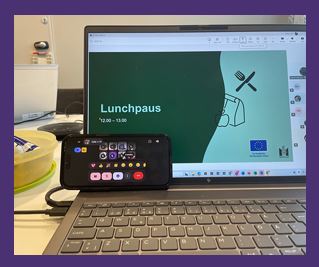
On 4 February, we gathered online for Sweden’s national digital dissemination event for the M‑STEM project – a full day filled with voices, stories, and insights from classrooms across Malmö.
What could have presented a simple walkthrough of our project website and all the material that has been created instead became a vivid and human presentation of what M‑STEM truly is: the daily work, courage and creativity of teachers and students. Throughout the day, proud teachers and brave students joined in short, dynamic sessions where all five participating Malmö schools contributed with
reflections, examples and experiences from their two‑year journey with AI, VR and the Metaverse.
The sessions were mixed with sessions describing the objectives of the project and all other relevant information about the project in smaller portions throughout the day.
From the very first session, it was clear how much progress the schools have made. Students from Rådmansvången shared how they joined the project because they wanted to learn more than in a regular technology classroom, how they went from having no experience with VR to feeling confident enough to teach others, and how working with peers from other countries during the mobility in Portugal broadened their understanding of language, cooperation and cultural diversity. Their comments set the tone for the entire event: technology is important, but the human encounters and the growing intercultural competence are just as central.
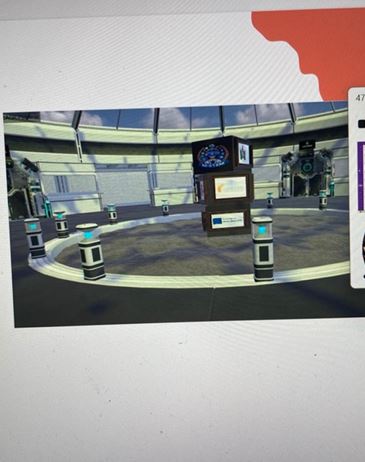
Teachers from Lorensborg Special needs school offered another powerful prspective when they described how meaningful it had been to take part in the full development process of the VR app – from writing scenarios to testing the finished product. As they explained, VR makes abstract concepts in science and technology more concrete for their students, who benefit greatly from multimodal and immersive learning environments. Because many of their students feel anxious in unfamiliar physical settings, VR allowed them to “travel” without leaving the safety of their classroom. Their students’ first structured encounter with pollen happened inside the VR lab, and the fascination was evident when they explored space, saw stars up close and stepped inside a virtual spaceship. The teachers also shared challenges such as the need for clearer visual support, easier navigation and multilingual options, but emphasised the significant learning gains and the fact that their students now expect VR to be part of their continued education.
From the very first session, it was clear how much progress the schools have made. Students from Rådmansvången shared how they joined the project because they wanted to learn more than in a regular technology classroom, how they went from having no experience with VR to feeling confident enough to teach others, and how working with peers from other countries during the mobility in Portugal broadened their understanding of language, cooperation and cultural diversity. Their comments set the tone for the entire event: technology is important, but the human encounters and the
growing intercultural competence are just as central.
Djupadalskolan presented their work with both VR and also creative AI in AdobeExpress, where fourth‑grade students learned to prompt in English and explore poetry through digital storytelling. Two classes presented their work for us with pride and they showed as much engagement, motivation and eagerness in a very humble way
here as well as they did hosting the group in October coming to Malmö. Their reflections showed how international collaboration motivates younger learners: several students expressed a wish to visit partner schools, meet their collaborators
again and improve their English. They also showcased their contribution to InnoCarnival, where they are working with greener and safer schoolyards.
The youngest presenters came from Västra skolan, where four confident pupils age 7 8 and their teacher explained how VR, AI, programming and digital creativity have become part of everyday learning in their school where they have 6 – 9 year old
students. They talked about building their own VR world “Clean the Ocean,” creating films in Adobe Express, making music with AI, and learning that AI is helpful only when used critically—”because sometimes it gets things completely wrong”. Their teacher described how the school’s “Digis” group, a digital ambassadors’ team with representatives from every class, has become a hub for teaching digital literacy, accessibility, netiquette, and emerging technologies. According to the teacher, VR has given all pupils a shared experience and a deeper understanding—“When we visited Egypt in VR, every child had ‘been there,’ and suddenly the subject came alive for all of them.
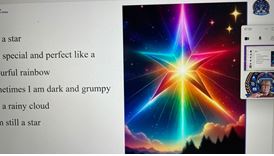
Then the students from Lindängeskolan shared their impressions from the mobility in Barcelos and it was clear to all of us listening how much the experience had meant to them. They talked about what it was like to work in mixed‑country groups and they described how quickly they learned to communicate, solve problems together and support one another despite language barriers.
One experience that particularly stood out was their meeting with Moisés, the doctoral researcher in VR for health. The students were fascinated by his demonstration of how VR can support physical rehabilitation, and several of them said afterwards that they had never thought of VR as something that could help people recover or train their bodies. It broadened
their understanding of what technology can be used for, beyond learning and also
entertainment.
They also reflected on the cultural aspects of the mobility — trying new food, hearing Portuguese everywhere, practising English in real situations, and realising that they could communicate much more than they expected.
Their teacher then offered a perspective that wove the students’ enthusiasm into the pedagogical core of M‑STEM. She explained that VR has become the final piece that completes their STEM and InnoCarnival work: learning begins with theory in the classroom, where students build an initial understanding of concepts such as weather, climate and extreme conditions.
When this is followed by practical activities — like investigating an extreme weather event and creating a meteorological report — students are able to apply and deepen their knowledge. What truly enhances the learning process, she said, is when interactive and digital elements are added. Immersive environments make knowledge more engaging, memorable and meaningful. The combination of theory, hands‑on work and VR strengthens students’ understanding, supports memory and motivation, and develops their ability to collaborate, communicate and reflect. VR does not replace teaching — it brings the entire learning process together in a real contex .
A teacher and a student from Lindängeskolan’s special needs school shared with us how VR has become a gateway to experiential learning for students differently abled.
Through themes such as sustainability, space, social emotions and global environments, students engaged deeply with stories, movement and visual exploration. They followed the narrative of a hedgehog struggling with belonging, acted as astronauts in a VR solar system and explored continents through immersive geography. The emotional reactions were strong, leading to rich discussions, creative activities and increased understanding of both content and feelings. As one student put it: “When I was an astronaut in VR, it felt real — and then I remembered the planets better.”
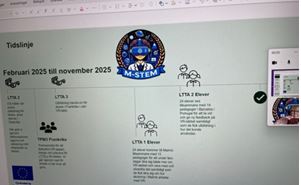
Behind all these stories lies the full M‑STEM structure: the pedagogical strategy developed in WP2, the set of twelve VR‑based lesson plans in WP3, and the international collaboration that has shaped the project from Turkey to Austria, France, Romania and Portugal. While these outcomes were introduced during the event, it was the teachers’ and students’ authentic examples that demonstrated how the materials have come alive in classrooms, how theory has been turned into action, and how immersive learning is becoming a natural part of school development.
As we closed the event, a metaphor emerged that captured the essence of the day: a diamond. Each presentation—each student, each teacher, each perspective—was like a different facet of that diamond, reflecting its own angle of light. Together, these contributions formed a whole that was strong, brilliant and valuable. That is what M‑STEM has become: a multifaceted, shared creation shaped by those who use it every day. And as our schools continue to work with VR, AI and STEM long after the project ends, the diamond will continue to shine